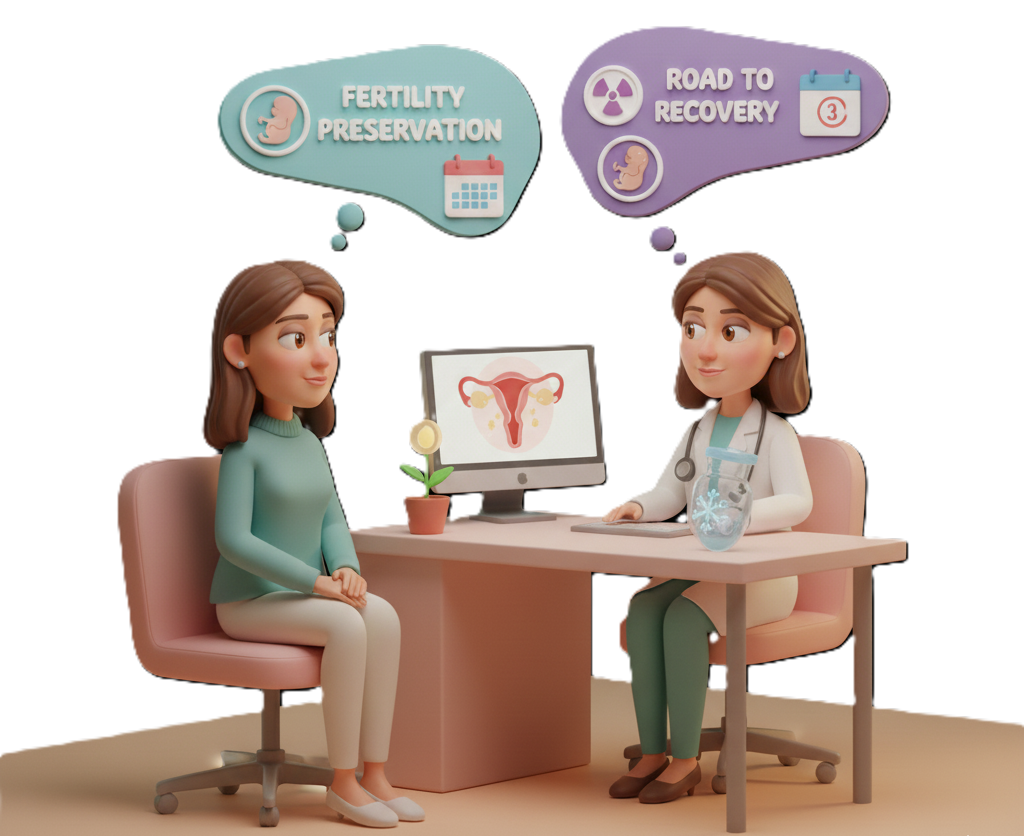
Fertility is the ability to produce children. A female’s fertility depends on a functioning reproductive system and endocrine system. These systems work together to help a female conceive and carry a pregnancy to term.
Whether your fertility is affected by cancer or its treatment depends on:
- the type of cancer treatment(s)
- the amount (dose) of treatment
- the length (duration) of treatment
- your age at the time of treatment
- the amount of time that has passed since treatment
- the type of cancer and if the tumor is near reproductive organs
- your baseline fertility status, including any fertility problems in the past
- other personal health conditions and factors
Cancer treatments may affect your fertility by harming reproductive organs and endocrine glands that control fertility. Changes to your fertility may be temporary or permanent. Treatments such as chemotherapy, radiation therapy, and hormone therapy can cause primary ovarian insufficiency, as explained in the section Primary ovarian insufficiency (POI) and cancer treatment.
Chemotherapy destroys cancer cells but can also harm healthy cells, such as those in the ovarian follicles, which contain oocytes (egg cells). Some types of chemotherapy pose a high risk to your fertility. For example, alkylating agents present a high risk to your fertility because they can cause the ovaries to stop developing mature eggs and producing estrogen. This can lead to primary ovarian insufficiency. You may be at greater risk of infertility if you receive high doses of chemotherapy or several chemotherapy drugs at the same time.
Hormone therapy, also called endocrine therapy, adds, blocks, or removes hormones (estrogen and progesterone). It may be used to stop or slow the growth of cancer that uses hormones to grow. This can cause primary ovarian insufficiency. Fertility-related side effects depend on the specific type of hormone therapy and may include symptoms such as those listed in the section Primary ovarian insufficiency (POI) and cancer treatment.
Research has found that some women being treated for breast cancer can stop hormone therapy while trying to become pregnant without raising the risk of recurrence in the short-term, according to initial results from the POSITIVE clinical trial.
Immunotherapy stimulates or suppresses your immune system to fight cancer. Immune checkpoint inhibitors are a type of immunotherapy drug used to treat some types of cancer. The effects of immunotherapy on fertility and pregnancy are still being studied. If your doctor recommends immunotherapy, ask what is known about the type of immunotherapy you will be receiving and how it may affect your fertility.
Radiation therapy destroys cancer cells or slows their growth. Radiation to your reproductive organs, pelvic region, or central nervous system can affect your fertility. The dose of radiation, the part of your body that received radiation, and your age all play a role in whether your fertility is affected. The type of radiation therapy used is also a factor. For example, proton beam radiation therapy and intensity-modulated radiation therapy may have less of an effect on your fertility than standard radiation therapy.
Pelvic region: Radiation therapy to or near reproductive organs (such as your cervix, fallopian tubes, ovaries, uterus, vagina, and vulva) in your pelvic region can damage ovaries or destroy eggs and may cause primary ovarian insufficiency. Radiation therapy near the uterus can affect the blood flow or cause scarring, which may cause infertility or increase the risk of pregnancy-related complications.
Central nervous system: Radiation therapy to your brain may affect glands that send signals to the ovaries to make the hormones estrogen and progesterone that are needed for ovulation. Learn about procedures that can help protect your fertility during radiation therapy in the section Fertility preservation methods for females.
Before having a stem cell transplant, also called a bone marrow transplant or hematopoietic cell transplant, you may receive high doses of chemotherapy, radiation therapy, or both. Because these treatments can damage the ovaries, they may cause primary ovarian insufficiency or infertility. Researchers are studying reduced-intensity conditioning regimens to determine if they can lower the risk of primary ovarian insufficiency or infertility.
Gonadotropin-releasing hormone agonists (GnRHa) are drugs that cause the ovaries to shut down and stop making estradiol, a form of estrogen. GnRHa is sometimes used as a hormone therapy for breast cancer in premenopausal females.
Ovarian shielding, also called gonadal shielding, is a procedure used to protect the ovaries during radiation therapy. Lead shields, also called lead aprons, are protective garments that placed over the ovaries and other reproductive organs to reduce the risk of scatter radiation.
Ovarian tissue freezing, also called ovarian tissue banking and ovarian tissue cryopreservation, refers to surgical removal and cryopreservation of egg-containing ovarian tissue. This tissue is later thawed and placed back into your body, for hormone production and egg release to resume. Females who have undergone ovarian tissue freezing and reimplantation have conceived with or without assistance.
Ovarian tissue freezing is a fertility preservation method for:
- girls who have not yet gone through puberty
- females who are advised not to delay cancer treatment for a fertility preservation procedure
- females who are advised not to receive hormonal treatments that are needed for some types of fertility preservation procedures
Ovarian transposition, also called oophoropexy, is an operation to move the ovaries, and sometimes the fallopian tubes, away from the area receiving radiation. This can lower their exposure to radiation. This procedure may be done during surgery to remove the cancer.
Radical trachelectomy (also called radical cervicectomy) is surgery used to treat women with early-stage cervical cancer who would like to become pregnant in the future. This operation removes the cervix, nearby tissue, the upper part of the vagina, and sometimes lymph nodes. The uterus, fallopian tubes, and ovaries remain in place. The uterus is then attached to the lower part of the vagina, with a special band that helps keep the uterus closed during pregnancy.
Even though cancer and cancer treatments can lower your fertility, there may still be a chance you could become pregnant. Some cancer treatments may be harmful or cause a miscarriage. Your doctor may advise using a method of birth control during treatment for cancer.
Before starting treatment, talk with your doctor about whether the recommended cancer treatment may affect your fertility:
- Could the proposed cancer treatment make it more difficult to become pregnant or carry a pregnancy in the future? Are there other cancer treatments that might not cause infertility or might cause fewer fertility problems?
- Would you recommend a fertility specialist, such as a reproductive endocrinologist, that I could talk with to learn more about methods to preserve my fertility?
- Would you recommend a social worker who could help me understand issues related to insurance coverage and cost of fertility preservation methods?
- Which fertility preservation method(s) do you advise for me? What fertility preservation methods are available at this hospital? At a fertility clinic?
- What methods of birth control should I use during treatment?
After completing treatment, ask your doctor:
- Should I use a method of birth control after treatment? If so, for how long?
- What are the chances that people who have this treatment become pregnant in the future?
- If fertility changes are temporary, how long might it take for my fertility to return?