Do you have stomach pain or bloatedness often after meals? Or do you not have regular bowel movements?If so, you might have been having digestive problems. According to a survey done in Singapore, digestive issues is one of the top 5 leading problems and 1 in 10 has digestive issues.[1] Some of the common symptoms include stomach pain, bloatedness, heartburn, diarrhoea, constipation, bleeding in stools, vomiting and nausea.

Common digestives issues are as listed:

IBS is a chronic disorder of the gastrointestinal system whereby patients exhibit symptoms of abdominal pain, bloating and changes in bowel habits, which could be either constipation, diarrhoea or both. Causes of IBS are not specifically known yet though research has shown that there is a relationship between IBS and the gut microbiome, gut immune system and also an individual’s mental health.

GERD occurs when stomach acid repeatedly flows back into the oesophagus (acid reflux), damaging oesophagus lining. Patients tend to experience a burning sensation in the chest area, regurgitation of food or sour liquid, trouble swallowing, cough and hoarseness. The acid reflux is caused by the weakening or abnormal relaxation of the lower esophageal sphincter. GERD can happen due to poor eating habits or consumption of food that is too taxing on the digestive system.

According to TCM, digestive issues is associated to Spleen-Stomach deficiency syndrome, Dampness-Heat syndrome and Liver Qi stagnation syndrome:

i. Spleen-Stomach deficiency syndrome

TCM believes that Spleen-Stomach is involved in the digestion of the food we take in, absorption of the nutrients and fluid from the digested food and circulation of the nutrients and fluids to other organs and the rest of our body. The nutrients and fluids are the source of Qi and blood which is vital for the proper functioning of our organs and body.[3]

As our society prospers and flourishes, the variety of food available to us vastly increases, and we tend to increase our daily food intake, resulting in the overworking of our Spleen-Stomach. This can damage our Spleen-Stomach in the long run, causing it to be deficient and unable to work at its full potential, which can affect the digestion, absorption, and circulation of nutrients and fluids

People with Spleen-Stomach deficiency will exhibit symptoms as such: poor appetite, bloatedness after eating, diarrhoea, and fatigue.

ii. Dampness-Heat syndrome

In the modern days where cooked food is easily available to us without having to step into our kitchen, we often eat out more due to our busy schedules. And what kind of food do we usually prefer? Fried, oily, sweet and spicy food! Frequent consumption of fried, oily, sweet and spicy food will cause the accumulation of Dampness-Heat pathogen in the Spleen-Stomach. The Dampness-Heat pathogen will then be trapped in the Spleen-Stomach as it is harder to be removed.

People with Dampness-Heat syndrome will exhibit symptoms as such: bloatedness, loss of appetite, nauseousness, bitterness in mouth, loose stools.

iii. Liver Qi stagnation

The Liver in TCM is said to govern our emotions and also the flow of Qi. The flow of Qi also helps to promote the distribution and flow of the nutrients and fluids in our body. In today’s fast-paced environment, we tend to be overwhelmed with work and this creates an imbalance in our work-life schedule, resulting in stress. The Liver will be put under constant stress, causing the Liver Qi to be trapped and unable to flow freely, eventually affecting the flow of the nutrients and fluids in our body.

People with Liver Qi stagnation will exhibit symptoms as such: moods fluctuation, bloatedness in the side and lower abdomen, tendency to sigh.

Studies have shown that women are more prone to suffering from digestive issues due to the slower rate of gastric emptying.[4] This is due to the nerve cells that control the intestines’ movement being slower in responding to the brain signals when comparing women to men.

Our gut, also known as the digestive system, is in charge of 4 things:

  1. Movement of the food through our digestive system
  2. Secretion of enzymes to break down the food
  3. Digestion of food into smaller molecules so that our body can use them
  4. Absorption of the smaller molecules and passing them to the bloodstream to be circulated throughout the body

When our gut health is not functioning optimally, our body will not be nourished by the food we eat. TCM believes that Spleen-Stomach is the acquired foundation (in tcm our KidneySpleen-Stomachand therefore is important for providing the Qi and Blood to our body and the other organs through the digestion and absorption of food.

Recent research on skin-gut communication has also shown that our gut microbiota play a role in immunity and a healthy gut will lead to lower inflammation, thus playing an important role in autoimmune and inflammatory skin diseases.

Lastly, gut health has also been researched extensively in the past few years to establish the relationship with the brain. Our gut health affects our mental health and vice versa. TCM also believes that the mood, which is governed by Liver, is associated closely with our gut, which is governed by our Spleen.

Gastrointestinal issues like bloatedness, diarrhoea, and constipation may be common, but when experienced frequently, can significantly impact a person’s quality of life.

If your symptoms persist for more than a few days, it could be a sign of a more serious condition that may progress into a chronic condition if left untreated. For example, heartburn can occur when stomach acid flows back into the oesophagus. If this happens frequently, it can lead to GERD, which can damage the oesophagus and make swallowing painful.

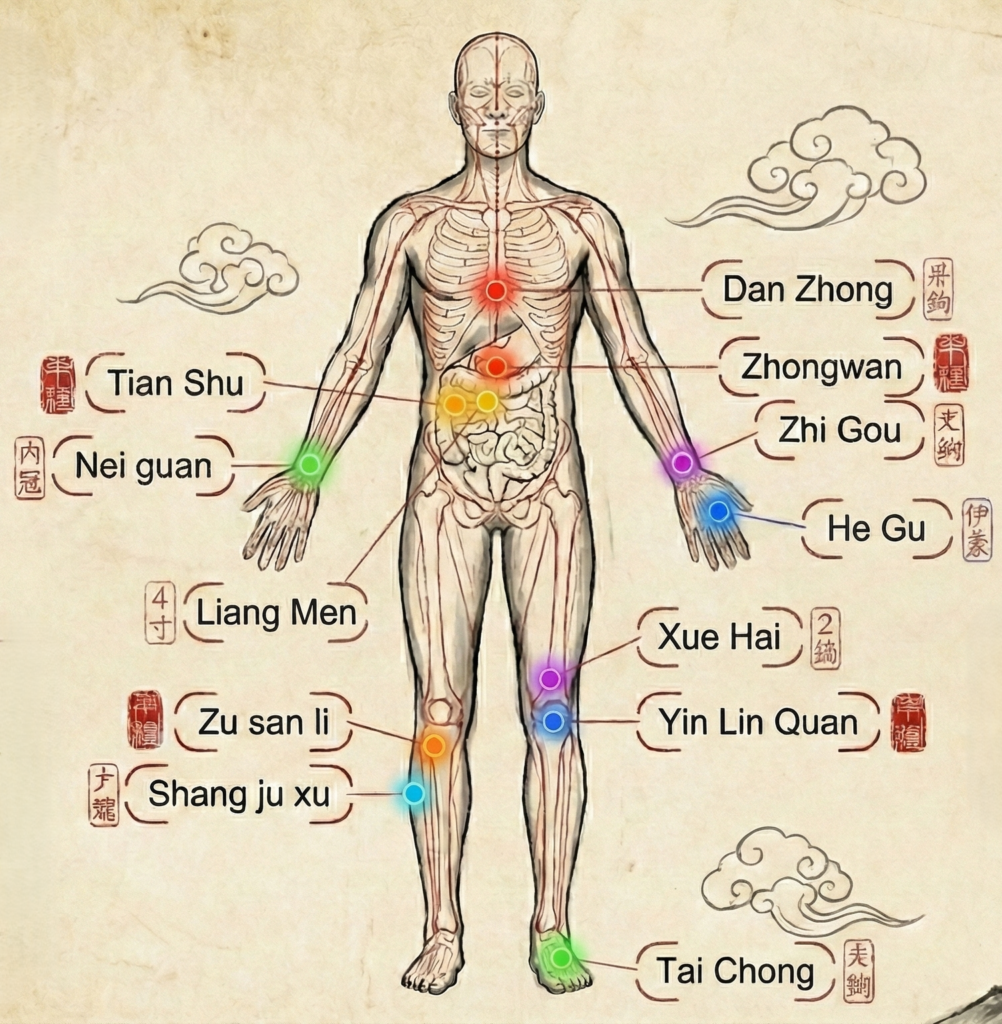
Try massaging these acupoints daily to help with the common digestive issues listed below:

Zhong WanNei Guan Zu San Li 

Tian ShuShang Ju Xu Yin Lin Quan 

Tian Shu Shang Ju XuZu San Li Zhi Gou 

Zhong WanNei GuanZu San LiDan Zhong 

TCM prescriptions like Ban Xia Xie Xin Tang contains herbs that can help to get rid of the heat and dampness in the Spleen-Stomach. Huang Qin and Huang Lian can help to clear the heat and dampness in the Shang, Zhong Jiao which will aid in the relief of the bloatedness. Bu Zhong Yi Qi Tang is normally used when one has Spleen-Stomach deficiency. Bai Zhu, Huang Qi, Dang Shen, Zhi Gan Cao can help to replenish the Spleen Qi, strengthening the Spleen to improve its digestive function.

For stress-related digestive problems, Chai Hu Shu Gan San could be used to ease the mood by reducing the Liver Qi stagnation. Chai Hu, Chen Pi, Zhi Qiao, Xiang Fu can help to circulate the Qi, thereby removing bloatedness.

Note: It is recommended to speak with a trusted physician to customise a personalised prescription for your body condition. Do not self-medicate.

Dietary Recommendations

  1. Limit certain food types: It is recommended to consume less raw, spicy, oily and cold food. These foods tend to be more taxing on the stomach. TCM believes that raw, spicy, oily and cold food are a source of heat and dampness pathogens which taxes our Spleen-Stomach and causes it to be overworked, resulting in poor digestion of food.

  2. Eat regularly: Take your meals regularly. Doing so will allow the body to form a circadian cycle to know when to secrete ghrelin (the hunger hormone). This will signal to the brain to take in food. Skipping meals will result in lower glucose level in the blood, causing the brain to be deprived of glucose and not working optimally. TCM believes that food is an important resource for the formation of Qi and blood. Without food, our body and organs would not be nourished and the organs would not be able to function properly.

Acupuncture is an effective method to relieve bloatedness and alleviate digestive issues. Specific acupoints can be targeted to restore balance:

  • Zhong Wan, Tian Shu, Liang Men, and Xue Hai: These points help to strengthen the Spleen-Stomach and aid in lessening digestive issues.
  • Tai Chong and He Gu: For stress-related digestive issues, these points can help to soothe Liver Qi stagnation and aid in the circulation of Qi.

Electro-Lymphatic Therapy (ELT) is a gentle and non-invasive therapy that can improve the circulation and drainage of our lymphatic system, simulating the effects of a lymphatic drainage massage but without the pain and pressure. ELT uses a machine to produce gentle electrical pulses that stimulate the lymphatic vessels and nodes, promoting the movement and drainage of lymph fluid. This therapy can be especially beneficial for patients who suffer from lymphedema or other conditions that result in lymphatic congestion.

For patients who have inflammation in their digestive system, improving lymphatic flow and drainage can help to clear the inflammation and thereby promote the recovery of the digestive system. Patients who tend to have a more stressful lifestyle will also tend to have higher amounts of inflammation and tighter shoulder muscles and ELT is a very good way to clear the inflammation and at the same time loosen those tight shoulder muscles!

  •  https://www.sma.org.sg/smj/4505/4505a1.pdf
  •  https://www.karger.com/Article/Abstract/435816
  •  https://www.ncbi.nlm.nih.gov/pmc/articles/PMC4767755/
  •  https://www.sciencedaily.com/releases/2015/03/150330134409.htm#:
  •  https://pubmed.ncbi.nlm.nih.gov/3598704/#
  •  https://onlinelibrary.wiley.com/doi/abs/10.1002/bies.201600008
  •  https://www.sciencedirect.com/science/article/pii/S0959438820300362
  •  https://www.frontiersin.org/articles/10.3389/fnins.2013.00121/full

Related Topics

Book your appointment TODAY!

Search on the closest Doctor to your location and book based on specialty. EARN 10 POINTS more with CuraPOINT.

BOOK
Edit Template