

Blisters generally do not need a healthcare provider to look at them. There are no tests or diagnostics for blisters.
Bruise
- Home
- Skin, Hair and Nails
- Bruise
A bruise is an area of skin discoloration. A bruise occurs when small blood vessels break and leak their contents into the soft tissue beneath the skin.
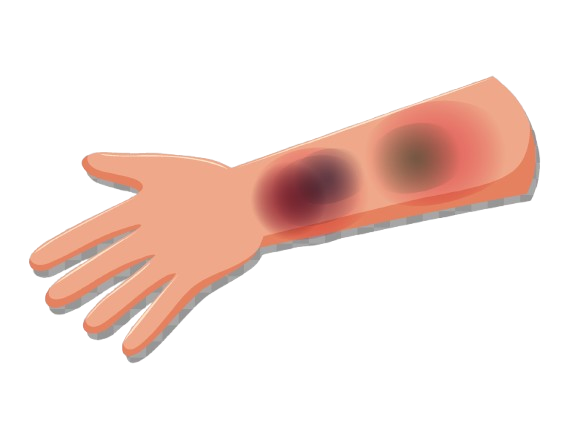
Bruises are often caused by falls, sports injuries, car accidents, or blows received from other people or objects.
If you take a blood thinner, such as aspirin, warfarin (Coumadin, Jantoven), dabigatran (Pradaxa), rivaroxaban (Xarelto), apixaban (Eliquis), or clopidogrel (Plavix), you are likely to bruise more easily.
Main symptoms are pain, swelling, and skin discoloration. The bruise begins as a pinkish red color that can be very tender to touch. It is often difficult to use the muscle that has been bruised. For example, a deep thigh bruise is painful when you walk or run.
Eventually, the bruise changes to a bluish color, then greenish-yellow, and finally returns to the normal skin color as it heals.
- Place ice on the bruise to help it heal faster and to reduce swelling. Wrap the ice in a clean towel. Do not place ice directly on the skin. Apply the ice for up to 15 minutes each hour.
- Keep the bruised area raised above the heart, if possible. This helps keep blood from pooling in the bruised tissue.
- Try to rest the bruised body part by not overworking your muscles in that area.
- If needed, take acetaminophen (Tylenol) to help reduce pain.
In the rare case of compartment syndrome, surgery is often done to relieve the extreme buildup of pressure. Compartment syndrome results from increased pressure on the soft tissues and structures beneath the skin. It can decrease the supply of blood and oxygen to the tissues.
There are three types of bruises:
- Subcutaneous — beneath the skin
- Intramuscular — within the belly of the underlying muscle
- Periosteal — bone bruise
Bruises can last from days to months. A bone bruise is the most severe and painful.
- Do not try to drain the bruise with a needle.
- Do not continue running, playing, or otherwise using the painful, bruised part of your body.
- Do not ignore the pain or swelling.
Contact your health care provider right away if you feel extreme pressure in a bruised part of your body, especially if the area is large or very painful. This may be due to compartment syndrome, and can be life-threatening. You should receive emergency care.
Also contact your provider if:
- You are bruising without any injury, fall, or other reason.
- There are signs of infection around the bruised area including streaks of redness, pus or other drainage, or fever.
Because bruises are usually the direct result of an injury, the following are important safety recommendations:
- Teach children how to be safe.
- Be mindful to avoid falls around the house. For example, be careful when climbing on ladders or other objects. Avoid standing or kneeling on counter tops.
- Wear seat belts in motor vehicles.
- Wear proper sports equipment to pad those areas most frequently bruised, such as thigh pads, hip guards, and elbow pads in football and hockey. Wear shin guards and knee pads in soccer and basketball.
Contusion; Hematoma
References
Buttaravoli PM, Leffler S, Herrington RR. Contusion: (bruise). In: Buttaravoli PM, Leffler S, Herrington RR, eds. Minor Emergencies. 4th ed. Philadelphia, PA: Elsevier; 2022:chap 134.
Cameron P, O’Reilly G. Trauma overview. In: Cameron P, Little M, Mitra B, Deasy C, eds. Textbook of Adult Emergency Medicine. 5th ed. Philadelphia, PA: Elsevier; 2020:chap 3.1.
Schafer AI. Approach to the patient with bleeding or thrombosis. In: Goldman L, Schafer AI, eds. Goldman-Cecil Medicine. 27th ed. Philadelphia, PA: Elsevier; 2024:chap 157.


Ad
Women have unique health issues. And some of the health issues that affect both men and women can affect women differently.
Book your appointment TODAY!
Search on the closest Doctor to your location and book based on specialty. EARN 10 POINTS more with CuraPOINT.
BOOK-
Find a healthcare provider near you
-
Call for support
-
Feel free to message us!
About Us
Curafile is a Medical Cyclopedia, biggest Healthcare Curated Network Globally, serves citizens, service providers in one place.
- Estonia - Qatar
Jordan - Saudi Arabia