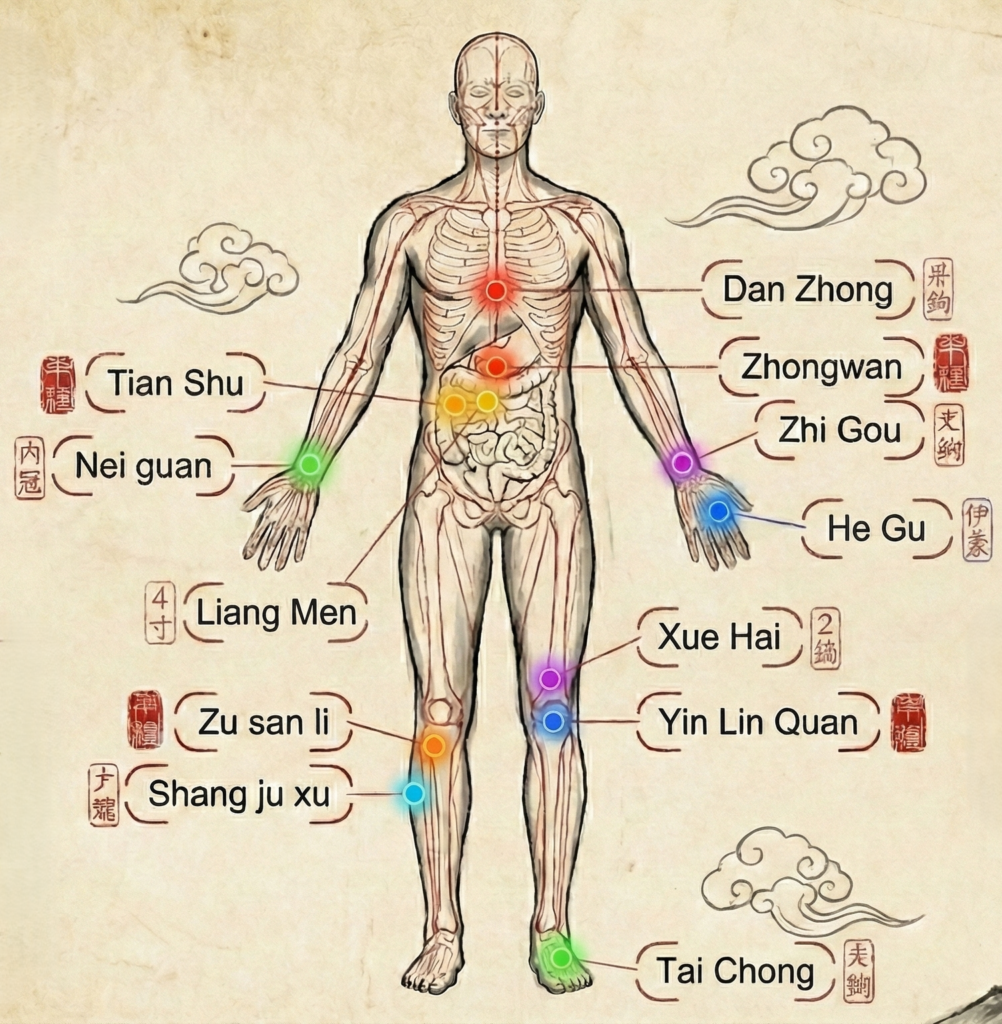
According to TCM, digestive issues is associated to Spleen-Stomach deficiency syndrome, Dampness-Heat syndrome and Liver Qi stagnation syndrome:
i. Spleen-Stomach deficiency syndrome
TCM believes that Spleen-Stomach is involved in the digestion of the food we take in, absorption of the nutrients and fluid from the digested food and circulation of the nutrients and fluids to other organs and the rest of our body. The nutrients and fluids are the source of Qi and blood which is vital for the proper functioning of our organs and body.[3]
As our society prospers and flourishes, the variety of food available to us vastly increases, and we tend to increase our daily food intake, resulting in the overworking of our Spleen-Stomach. This can damage our Spleen-Stomach in the long run, causing it to be deficient and unable to work at its full potential, which can affect the digestion, absorption, and circulation of nutrients and fluids
People with Spleen-Stomach deficiency will exhibit symptoms as such: poor appetite, bloatedness after eating, diarrhoea, and fatigue.
ii. Dampness-Heat syndrome
In the modern days where cooked food is easily available to us without having to step into our kitchen, we often eat out more due to our busy schedules. And what kind of food do we usually prefer? Fried, oily, sweet and spicy food! Frequent consumption of fried, oily, sweet and spicy food will cause the accumulation of Dampness-Heat pathogen in the Spleen-Stomach. The Dampness-Heat pathogen will then be trapped in the Spleen-Stomach as it is harder to be removed.
People with Dampness-Heat syndrome will exhibit symptoms as such: bloatedness, loss of appetite, nauseousness, bitterness in mouth, loose stools.
iii. Liver Qi stagnation
The Liver in TCM is said to govern our emotions and also the flow of Qi. The flow of Qi also helps to promote the distribution and flow of the nutrients and fluids in our body. In today’s fast-paced environment, we tend to be overwhelmed with work and this creates an imbalance in our work-life schedule, resulting in stress. The Liver will be put under constant stress, causing the Liver Qi to be trapped and unable to flow freely, eventually affecting the flow of the nutrients and fluids in our body.
People with Liver Qi stagnation will exhibit symptoms as such: moods fluctuation, bloatedness in the side and lower abdomen, tendency to sigh.
Studies have shown that women are more prone to suffering from digestive issues due to the slower rate of gastric emptying.[4] This is due to the nerve cells that control the intestines’ movement being slower in responding to the brain signals when comparing women to men.
Our gut, also known as the digestive system, is in charge of 4 things:
- Movement of the food through our digestive system
- Secretion of enzymes to break down the food
- Digestion of food into smaller molecules so that our body can use them
- Absorption of the smaller molecules and passing them to the bloodstream to be circulated throughout the body
When our gut health is not functioning optimally, our body will not be nourished by the food we eat. TCM believes that Spleen-Stomach is the acquired foundation (in tcm our Kidney ,Spleen-Stomachand therefore is important for providing the Qi and Blood to our body and the other organs through the digestion and absorption of food.
Recent research on skin-gut communication has also shown that our gut microbiota play a role in immunity and a healthy gut will lead to lower inflammation, thus playing an important role in autoimmune and inflammatory skin diseases.
Lastly, gut health has also been researched extensively in the past few years to establish the relationship with the brain. Our gut health affects our mental health and vice versa. TCM also believes that the mood, which is governed by Liver, is associated closely with our gut, which is governed by our Spleen.