

Many foods contain carbohydrates (carbs), including:
- Fruit and fruit juice.
- Cereal, bread, pasta, and rice.
- Milk and milk products, soy milk.
- Beans, legumes, and lentils.
- Starchy vegetables like potatoes and corn.
- Sweets like cookies, candy, cake, jam and jelly, honey, and other foods that contain added sugar.
- Snack foods like chips and crackers.
Your body quickly turns carbohydrates into a sugar called glucose, which is your body’s main source of energy. This raises your blood sugar, or blood glucose level.
Most foods that contain carbohydrates are nutritious and are an important part of a healthy diet. For people with diabetes, the goal is not to avoid carbohydrates in the diet completely, but to make sure that you are not eating too many. Eating a regular amount of carbohydrates throughout the day can help keep your blood sugar level steady.
People with diabetes can better control their blood sugar if they count how many carbohydrates they eat. People with diabetes who take insulin can use carb counting to help them determine the exact dose of insulin they need at meals.
Your dietitian or diabetes educator will teach you a technique called carb counting.
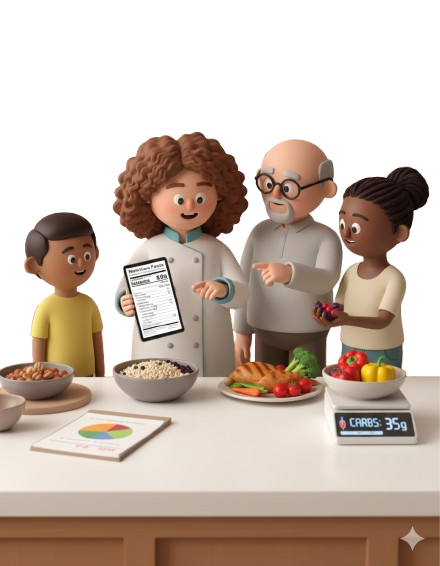
Your body turns all carbohydrates into energy. There are 3 major types of carbohydrates:
- Sugars.
- Starches.
- Fiber.
Sugars are found naturally in some foods and added to others. Sugar occurs naturally in these nutrient-rich foods:
- Fruits.
- Milk and milk products.
Many packaged and refined foods contain added sugar:
- Candy.
- Cookies, cakes, and pastries.
- Regular (non-diet) carbonated beverages, such as soda.
- Heavy syrups, such as those added to canned fruit.
Starches are found naturally in foods, as well. Your body breaks them down into sugar after you eat them. The following foods have a lot of starch. Many also have fiber. Fiber is the part of food that is not broken down by the body. It slows digestion and helps you feel fuller. Foods containing starch and fiber include:
- Bread.
- Cereal.
- Legumes, such as beans and chickpeas.
- Pasta.
- Rice.
- Starchy vegetables, such as potatoes.
Some foods, such as jelly beans, contain only carbohydrates. Other foods, such as animal proteins (all kinds of meat, fish, and eggs), have no carbohydrates.
Most foods, even vegetables, have some carbohydrates. But most green, non-starchy vegetables are very low in carbohydrates.
Most adults with diabetes should eat no more than 200 carbohydrate grams per day. The daily recommended amount for adults is 135 grams per day, but each person should have their own carbohydrate goal. Pregnant women need at least 175 grams of carbohydrates each day.
Packaged foods have labels that tell you how many carbohydrates a food has. They are measured in grams. You can use food labels to count the carbohydrates that you eat. When you are carb counting, a serving (sometimes also called a carb) equals an amount of food that contains 15 grams of carbohydrate. The serving size listed on a package is not always the same as 1 serving in carbohydrate counting. For example, if a single-serving package of food contains 30 grams of carbohydrate, the package actually contains 2 carbohydrate servings (or carbs) when you are carb counting.
The food label will say what 1 serving size is and how many servings are in the package. If a bag of chips says that it contains 2 servings and you eat the entire bag, then you will need to multiply the label information by 2 to know how much of the nutrients you have eaten. For example, let’s say the label on a bag of chips states that it contains 2 servings, and 1 serving of chips provides 11 grams of carbohydrate. If you eat the entire bag of chips, you have eaten 22 grams of carbohydrates.
The label will list sugar and fiber separately. The carbohydrate count for a food includes sugar and fiber plus the starch. The grams of starch are not explicitly indicated on the nutrition facts label. Use only the total number to count your carbs.
When you count carbs in foods that you cook, you will have to measure the portion of food after cooking it. For example, cooked long grain rice has 15 grams of carbohydrate per 1/3 cup. If you eat a cup of cooked long grain rice, you will be eating 45 grams of carbohydrates, or 3 carbohydrate servings.
Here are some examples of foods and servings sizes that have approximately 15 grams of carbohydrate:
- Half cup (107 grams) of canned fruit (without the juice or syrup).
- One cup (109 grams) of melon or berries.
- Two tablespoons (19 grams) of dried fruit (such as raisins)
- Half cup (121 grams) of cooked oatmeal.
- One-third cup of cooked pasta (44 grams) (can vary with the shape).
- One-third cup (67 grams) of cooked long grain rice.
- One-fourth cup (51 grams) of cooked short grain rice.
- Half cup (88 grams) cooked beans, peas, or corn.
- One oz (28 grams) slice of bread.
- Three cups (33 grams) popcorn (popped).
- One cup (240 milliliters) milk or soy milk.
- Three ounces (84 grams) of baked potato.
The total amount of carbohydrates you eat in a day is the sum of the carbohydrates in everything you eat.
When you are learning how to count carbs, use a log book, a sheet of paper, or an app to help you track them. As time passes, it will get easier to estimate your carbohydrates.
Plan to see a dietitian every 6 months. This will help you refresh your knowledge of carb counting. A dietitian can help you determine the right amount of carbohydrate servings to eat each day, based on your personal caloric needs and other factors. The dietitian can also recommend how to distribute your daily carbohydrate intake evenly among your meals and snacks.
Diabetes is diagnosed with the following blood tests:
- Fasting blood glucose level — Diabetes is diagnosed if it is 126 mg/dL (7 mmol/L) or higher two different times while in the usual state of health.
- Random (non-fasting) blood glucose level — You may have diabetes if it is 200 mg/dL (11.1 mmol/L) or higher. (This must be confirmed with a fasting test.)
- Oral glucose tolerance test — Diabetes is diagnosed if the glucose level is 200 mg/dL (11.1 mmol/L) or higher 2 hours after you drink a special sugar drink.
- Hemoglobin A1C (A1C) test — Diabetes is diagnosed if the result of the test is 6.5% or higher.
Ketone testing is also used sometimes. The ketone test is done using a urine sample or blood sample. Ketone testing may be done to determine if someone with type 1 diabetes has had ketoacidosis. Testing is usually done:
- When the blood sugar is higher than 240 mg/dL (13.3 mmol/L).
- During an illness such as pneumonia, heart attack, or stroke.
- When nausea and vomiting occur.
- During pregnancy.
The following exams and tests will help you and your health care provider monitor your diabetes and prevent problems caused by diabetes:
- Check the skin and bones on your feet and legs.
- Check if your feet are getting numb (diabetic nerve disease).
- Have your blood pressure checked at least once a year. The goal should be lower than 130/80 millimeters of mercury (mmHg).
- Have an A1C test done every 6 months if your diabetes is well controlled. Have the test done every 3 months if your diabetes is not well controlled.
- Have your cholesterol and triglyceride levels checked once a year.
- Get tests once a year to make sure your kidneys are working well. These tests include checking levels of urine albumin (microalbuminuria) and serum creatinine.
- Visit your eye doctor at least once a year, or more often if you have signs of diabetic eye disease, once you have had type 1 diabetes for 5 years.
- See your dentist every 6 months for a thorough dental cleaning and exam. Make sure your dentist and hygienist know that you have diabetes.
Some people take insulin to help manage their diabetes.
Your dose may change, depending on the amount of carbs you ate at a meal and the difference between your target blood sugar level and your actual reading. You’ll need to know your “insulin-to-carbohydrate ratio,” or the number of carbs one unit of insulin will cover. Generally, one unit of fast-acting insulin covers 12-15 grams of carbohydrates.
Your body can also be more sensitive to insulin changes throughout the day. Stress or how much you exercise also has an impact. It’s important to work out a plan with your doctor for how to change your treatment if you need to.
Carb counting; Carbohydrate-controlled diet; Diabetic diet; Diabetes-counting carbohydrate
References
American Diabetes Association website. Carb counting and diabetes. diabetes.org/food-nutrition/understanding-carbs/carb-counting-and-diabetes. Accessed August 6, 2024.
Hirsch IB, D’Alessio D, Ehrhardt N, Evert AB, Gilliam LK, Riddell M. Clinical management of type 2 diabetes mellitus. In: Robertson RP, ed. DeGroot’s Endocrinology. 8th ed. Philadelphia, PA: Elsevier; 2023:chap 40.
Retnakaran R, Peters AL. Treatment of type 1 diabetes in adults. In: Robertson RP, ed. DeGroot’s Endocrinology. 8th ed. Philadelphia, PA: Elsevier; 2023:chap 39.
WebMD https://www.webmd.com/diabetes/diabetes-how-count-carbs How to Count Carbs

Ad
Women have unique health issues. And some of the health issues that affect both men and women can affect women differently.
Book your appointment TODAY!
Search on the closest Doctor to your location and book based on specialty. EARN 10 POINTS more with CuraPOINT.
BOOK-
Find a healthcare provider near you
-
Call for support
-
Feel free to message us!
About Us
Curafile is a Medical Cyclopedia, biggest Healthcare Curated Network Globally, serves citizens, service providers in one place.
- Estonia - Qatar
Jordan - Saudi Arabia