

Vaginal or Uterine Bleeding
- Home
- Female Reproductive System
- Vaginal or Uterine Bleeding
Vaginal bleeding normally occurs during a woman’s menstrual cycle, when she gets her period. Every woman’s period is different.
- Most women have periods between 24 and 34 days apart. It usually lasts 4 to 7 days in most cases.
- Young girls may get their periods anywhere from 21 to 45 days or more apart.
- Women in their 40s will often notice their period occurring less often.
Many women have abnormal bleeding between their periods at some point in their lives. Abnormal bleeding means you have:
- Heavier bleeding than usual
- Bleeding for more days than normal (menorrhagia)
- Spotting or bleeding between periods
- Bleeding after sex
- Bleeding after menopause
- Bleeding while pregnant
- Bleeding before age 9
- Menstrual cycles longer than 35 days or shorter than 21 days
- No period for 3 to 6 months (amenorrhea)
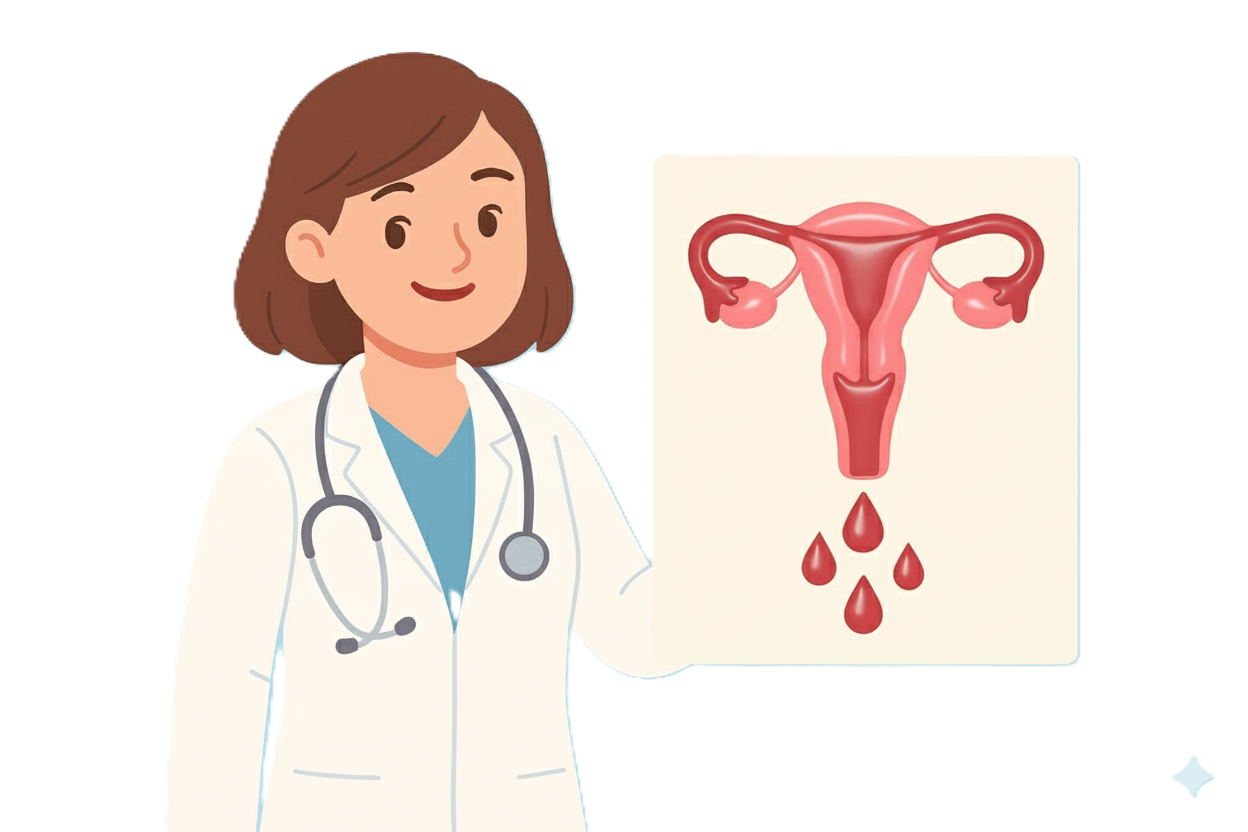
There are many causes of abnormal vaginal bleeding.
HORMONES
Abnormal bleeding is often linked to failure of regular ovulation (anovulation). Health care providers call the problem abnormal uterine bleeding (AUB) or anovulatory uterine bleeding. AUB is more common in teenagers and in women who are approaching menopause.
Women who take oral contraceptives may experience episodes of abnormal vaginal bleeding. Often this is called “breakthrough bleeding.” This problem often goes away on its own. However, talk to your provider if you have concerns about the bleeding.
PREGNANCY
Pregnancy complications such as:
- Ectopic pregnancy
- Miscarriage
- Threatened miscarriage
PROBLEMS WITH REPRODUCTIVE ORGANS
Problems with reproductive organs may include:
- Infection in the uterus (pelvic inflammatory disease)
- Recent injury or surgery to the uterus
- Noncancerous growths in the uterus, including uterine fibroids, uterine or cervical polyps, and adenomyosis
- Inflammation or infection of the cervix (cervicitis)
- Injury or disease of the vaginal opening (caused by intercourse, infection, polyp, genital warts, ulcer, or varicose veins)
- Endometrial hyperplasia (thickening or build-up of the lining of the uterus)
MEDICAL CONDITIONS
Problems with medical conditions may include:
- Polycystic ovary syndrome
- Cancer or precancer of the cervix, uterus, ovary, or fallopian tube
- Thyroid or pituitary disorders
- Diabetes
- Cirrhosis of the liver
- Systemic lupus erythematosus
- Bleeding disorders
OTHER CAUSES
Other causes may include:
- Use of an intrauterine device (IUD) for birth control (may cause spotting)
- Cervical or endometrial biopsy or other procedures
- Changes in exercise routine
- Diet changes
- Recent weight loss or gain
- Stress
- Use of certain medicines such as blood thinners (Warfarin or Coumadin)
- Sexual abuse
- An object in the vagina
- Effect of low estrogen levels on the vaginal tissue
Symptoms of abnormal vaginal bleeding include:
- Bleeding or spotting between periods
- Bleeding after sex
- Bleeding more heavily (passing large clots, needing to change protection during the night, soaking through a sanitary pad or tampon every hour for 2 to 3 hours in a row)
- Bleeding for more days than normal or for more than 7 days
- Menstrual periods less than 28 days (more common) or more than 35 days apart
- Bleeding after you have gone through menopause
- Heavy bleeding associated with anemia (low blood count, low iron)
Bleeding from the rectum or blood in the urine may be mistaken for vaginal bleeding. To know for certain, insert a tampon into the vagina and check for bleeding.
Keep a record of your symptoms and bring these notes to your provider. Your record should include:
- When menstruation begins and ends
- How much flow you have (count numbers of pads and tampons used, noting whether they are soaked)
- Bleeding between periods and after sex
- Any other symptoms you have
Your provider will perform a physical exam, including a pelvic exam. Your provider will ask questions about your medical history and symptoms.
You may have certain tests, including:
- Pap test
- HPV test
- Urinalysis
- Thyroid function tests
- Complete blood count (CBC)
- Iron level
- Pregnancy test
Based on your symptoms, other tests may be needed. Some can be done in your provider’s office. Others may be done at a hospital or surgical center:
- Sonohysterography: Fluid is placed in the uterus through a thin tube, while vaginal ultrasound images are made of the uterus.
- Ultrasound: Sound waves are used to make a picture of the pelvic organs. The ultrasound may be performed abdominally or vaginally.
- Magnetic resonance imaging (MRI): In this imaging test, powerful magnets are used to create images of internal organs.
- Hysteroscopy: A thin telescope-like device is inserted through the vagina and the opening of the cervix. It lets the provider view the inside of the uterus.
- Endometrial biopsy: Using a small or thin catheter (tube), tissue is taken from the lining of the uterus (endometrium). It is looked at under a microscope.
The treatment depends on the specific cause of the vaginal bleeding, including:
- Hormonal changes
- Endometriosis
- Uterine fibroids
- Ectopic pregnancy
- Polycystic ovary syndrome
The treatment may include hormonal medicines, pain relievers, and possibly surgery.
The type of hormone you take will depend on whether you want to get pregnant as well as your age.
- Birth control pills can help make your periods more regular.
- Hormones also can be given as an injection, a skin patch, a vaginal cream, or through an IUD that releases hormones.
- An IUD is a birth control device that is inserted in the uterus. The hormones in the IUD are released slowly and may control abnormal bleeding.
Other medicines given for AUB may include:
- Nonsteroidal anti-inflammatory drugs (ibuprofen or naproxen) to help control bleeding and reduce menstrual cramps
- Tranexamic acid to help treat heavy menstrual bleeding
- Antibiotics to treat infections
Procedures for AUB may include:
- Endometrial ablation
- Surgical removal of benign growths
- Procedures to block the blood supply to uterine vessels (uterine artery embolization)
- Hysterectomy
Contact your provider if:
- You have soaked through a pad or tampon every hour for 2 to 3 hours.
- Your bleeding lasts longer than 1 week.
- You have vaginal bleeding and you are pregnant or could be pregnant.
- You have severe pain, especially if you also have pain when not menstruating.
- Your periods have been heavy or prolonged for three or more cycles, compared to what is normal for you.
- You have bleeding or spotting after reaching menopause.
- You have bleeding or spotting between periods or caused by having sex.
- Abnormal bleeding returns.
- Bleeding increases or becomes severe enough to cause weakness or lightheadedness.
- You have fever or pain in the lower abdomen.
- Your symptoms become more severe or frequent.
Aspirin may prolong bleeding and should be avoided if you have bleeding problems. Ibuprofen most often works better than aspirin for relieving menstrual cramps. It also may reduce the amount of blood you lose during a period.
Irregular menstruation; Heavy, prolonged, or irregular periods; Menorrhagia; Polymenorrhea; Metrorrhagia and other menstrual conditions; Abnormal menstrual periods; Abnormal vaginal bleeding
References
Bulun SE, Babayev E. Physiology and pathology of the female reproductive axis. In: Melmed S, Auchus, RJ, Goldfine AB, Rosen CJ, Kopp PA, eds. Williams Textbook of Endocrinology. 15th ed. Philadelphia, PA: Elsevier; 2025:chap 15.
Ryntz T, Lobo RA. Abnormal uterine bleeding: etiology and management of acute and chronic excessive bleeding. In: Gershenson DM, Lentz GM, Valea FA, Lobo RA, eds. Comprehensive Gynecology. 8th ed. Philadelphia, PA: Elsevier; 2022:chap 26.
Seller RH, Symons AB. Menstrual irregularities. In: Seller RH, Symons AB, eds. Differential Diagnosis of Common Complaints. 7th ed. Philadelphia, PA: Elsevier; 2018:chap 20.

Ad
Women have unique health issues. And some of the health issues that affect both men and women can affect women differently.
Book your appointment TODAY!
Search on the closest Doctor to your location and book based on specialty. EARN 10 POINTS more with CuraPOINT.
BOOK-
Find a healthcare provider near you
-
Call for support
-
Feel free to message us!
About Us
Curafile is a Medical Cyclopedia, biggest Healthcare Curated Network Globally, serves citizens, service providers in one place.
- Estonia - Qatar
Jordan - Saudi Arabia