

Balance isn’t about cramming in self-care—it’s about making space for what actually fuels you. A well-rounded day includes work (your goals and responsibilities), play (joyful activities that make life fun), and rest (time to recharge). The secret? Keep it simple, stay flexible, and stop treating productivity as the only thing that matters. Use the Balanced Self Wheel to map it out, and watch how much better your days feel.
Balanced Daily Routine
- Home
- Worker Health
- Balanced Daily Routine
-
Work hard, play hard and
Rest harder - The Balanced Self Wheel
-
The 3 elements of a balanced
Daily routine - Work
- Play
- Rest
- What to do next
- Final thoughts
When achieving daily work-life balance, it’s essential that you split your day up into sections, as this will make it easier to navigate.
The 3 elements of any balanced daily routine are:
- Work
- Play
- Rest
Within this blog post, I’m going to break down each fundamental so you can get a better hold on what I mean by them.
I’ll also show you how you can implement each one into your day using a pie chart so you can feel even more balanced.
But before we get started, I want to point out how essential it is to regularly revisit your daily routine.
If you’re a creature of habit (like me), it’s easy to fall into the pattern of always doing the same thing, whether it’s working for you or not.
So I want you to start treating your daily routine like you would your skincare routine.
If your face cream is making you break out in a rash, then chances are you wouldn’t continue to use it. So if your current daily routine isn’t making you more productive and leading to burnout, then why would you stick to it?
Don’t be scared of switching things up every so often and testing out new ways of doing things, like the concepts within this blog post.
A good work-life balance is not one-size-fits-all.
It’s about doing what works for you every single day so you can feel healthier and more fulfilled.
So every morning, get into the habit of asking yourself, “What does my day need to look like for me to feel balanced?”
Be mindful that this will look different each day.
For example, maybe tomorrow you’ll want to spend more time resting and practising self-care. But the next day is all about being productive and reserving your evening for having dinner with friends.
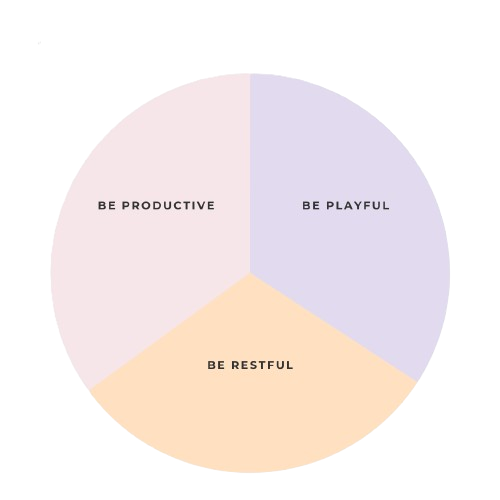
Get visual and use the steps below to balance your day by creating a 3-section pie chart.
I like to call this The Balanced Self Wheel.
Here’s how it works:
Step 1 = On a piece of paper, draw a circle
Step 2 = Divide this circle into 3 equal parts
Step 3 = Write one of these phrases in each segment of your wheel, leaving space below:
- Be productive
- Be playful
- Be restful
Step 4 = Continue reading this blog post to find out what to write within each section
I feel like work-life balance is always being marketed as this elusive thing that is impossible to find.
But the truth is, balance is not something you find — it’s something you create.
And creating balance can be as simple as taking a 5-minute break after a work meeting to regroup and reset.
Achieving work-life balance does not necessarily look like juggling multiple work commitments and social events with 2 hours of self-care each day without feeling overwhelmed.
Your work-life balance can simply be having 20 minutes to yourself in the evening, where you do whatever you want.
So don’t overcomplicate things by overcommitting to self-care and making loads of social plans to reach a “work-life balance”.
Remember that The Balanced Self Wheel represents just one day. Don’t go overboard by filling up each area to the brim, as this will just lead to overwhelm.
Instead, strip it right the way back and focus only on 1-3 simple things for each area.
I encourage you to bookmark this post so you can refer back to it whenever you need to.
No matter how much I try to argue, work will always come first on my daily schedule. Purely because work gives me a reason to wake up in the morning — a purpose.
I’ve finally gotten to a place where I am excited by my work, and I get to wake up every day doing what I love — blogging, coaching and connecting.
So yes, although I follow an “anti-hustle” approach to life and prefer slow living to fast living, work is still my top priority (after my health, of course).
And I am not ashamed to admit that.
Although in the past, I’ve suggested scheduling non-work activities first, I’ve now started to do the opposite. What can I say?! I’m in my plan work first era!
But this has all come down to me recognising my needs and understanding what I need to do to feel balanced. And right now, that is focusing on my work. (I guess this has stemmed from the fact that I spent the majority of last year travelling and dedicating my time to self-care.)
So every Sunday, as part of my reset routine, I make a list of all the tasks I need to do that week that will bring me closer towards my goals.
I already have a pretty good idea of this as my weekly tasks are usually the same. I then use the method of “theming my days” to organise these tasks throughout the week.
I don’t like to overload my todo list with loads of tasks, so I focus on only 1-3 priorities each day. This allows me some flexibility as well if one task ends up taking longer than the other, or my day doesn’t go as expected.
Writing down my top priorities for each day gives me a clearer picture of my schedule. I can then use this as the basis of how I balance my day.
For example, I’m usually busier mid-week as I like to use Monday and Tuesday to ease into my flow after the weekend. This means that I might have 3 important tasks on a Wednesday but only 1 or 2 on a Monday or Tuesday.
This shows me that I can dedicate more time at the beginning of the week to play and rest. As a result, I make sure to schedule up to 3 self-care activities for each area on a Monday and Tuesday, whereas on a Wednesday, I’ll only schedule one activity.
When I talk about “play”, I’m not talking about the modern version of “play hard” and party.
Play to me means spending time engaging in fun, recreational activities that invite more joy into my life.
As kids, we’re encouraged to go outside and play — to climb trees, jump in puddles and make friendship bracelets. But when we grow up and become adults, we’re not encouraged to have fun like we used to when we were kids.
Instead, heading out to the club, drinking alcohol and sleeping with strangers seems to be the right type of “fun” when you’re in your twenties. (I mean it was for me anyway.) But now that I am in my thirties and have grown out of partying, I cultivate fun in other ways.
This, for me, looks like doing jigsaw puzzles, socialising with friends over dinner, and connecting to my inner child to do the things I used to do as a kid.
So, stop taking life so seriously all the time and loosen the grip on being an adult.
Because amidst all your responsibilities, you deserve to have some fun.
And as Ralph Waldo Emerson once said, “Playtime is an essential part of our daily routine.” So do not skip this step!
You’ll also find that by making your daily routine more fun, you’ll feel more inspired to stick to it.
Before filling in the “be playful” section of your wheel, I want you to write a feel-good activities list. Write down all the activities that you like to do for fun. For example, socialising with friends, trying out a new hobby, going to the movies, etc.
Keep going until you have at least 10-15 activities.
Unlike play, rest allows you to spend time by yourself and engage in activities that help you decompress from the day.
They are not necessarily high-energy or fun activities, but are more calming rituals that help to relax and nourish your mind and body. For example, reading for 20 minutes as soon as you wake up, going for a walk in nature or simply sitting in silence and focusing on your breath.
These rituals can, of course, still bring you joy.
Self-care is an essential element of any balanced daily routine. Because you cannot show up and perform at your best if you are not taking care of yourself first. And rest allows you to do this.
And just so we’re on the same page, resting goes far beyond getting enough sleep each night.
In fact, there are 7 types of rest to choose from:
- Physical rest restores the body
- Mental rest allows your brain to repair
- Social rest gives you a break from socialising
- Sensory rest helps you to disconnect from “the noise”
- Spiritual rest provides you with a sense of meaning
- Emotional rest reduces stress, overwhelm and anxious thoughts
- Creative rest protects your creative energy
So choose the area that best suits your needs each day.
As I said at the beginning of this blog post, your self-care routine does not need to be overly long or complicated. It can be as quick as 10 minutes. Just as long as the rituals you choose allow you to feel refreshed and nourished.
Write down a long list of things you like to do to decompress after a long day. Keep going until you have at least 10-15 activities.
When filling in the last segment of the wheel — “be restful”, choose at least 1-3 activities (depending on your needs) to add to your daily routine each day.
You can stick with the same activities each day or switch them up depending on what you need — it’s entirely up to you.
Now that you have a completed wheel, it’s up to you to find the time to schedule in your activities.
Just because you’ve written them down doesn’t mean you’re actually going to do them. You need to commit to them just like you would with work commitments.
So start treating self-care as a non-negotiable and keep yourself accountable.
Pinpoint a time now in your schedule when you can dedicate time to play and rest today (assuming you’re already deep into your work).
You’re also more likely to do something if there is a trigger to prompt you. Set an alarm to remind you, and when it goes off, tell yourself that it is time for a self-care break what ever that looks like for you.
And stay consistent!
It can take up to 6 weeks to firmly establish a new habit, so if you start using the Balanced Self Wheel today, you are one step closer to forming a more balanced daily routine.
I am on a mission to promote a healthy work-life balance. One where productivity and self-care can work side by side, and you don’t need to sacrifice one over the other.
And despite what others will have you believe, this doesn’t need to be as complicated as it seems.
Incorporating play and rest into your schedule (no matter how long or short each activity is) alongside your work commitments is a simple and tangible way to achieve work-life balance.
Remember, there is no one-size-fits-all approach to creating a healthy and fulfilling life.
References
Work, Play and Rest; The 3 Elements of a Balanced Daily Routine, notes by thalia, notesbythalia.com/work-play-rest-the-elements-of-a-balanced-daily-routine/
Related Topics

Stay away from bad habits
Athletes Health
Worker health focuses on protecting employees’ physical and mental well-being in the workplace.
Book your appointment TODAY!
Search on the closest Doctor to your location and book based on specialty. EARN 10 POINTS more with CuraPOINT.
BOOK-
Find a healthcare provider near you
-
Call for support
-
Feel free to message us!
About Us
Curafile is a Medical Cyclopedia, biggest Healthcare Curated Network Globally, serves citizens, service providers in one place.
- Estonia - Qatar
Jordan - Saudi Arabia