
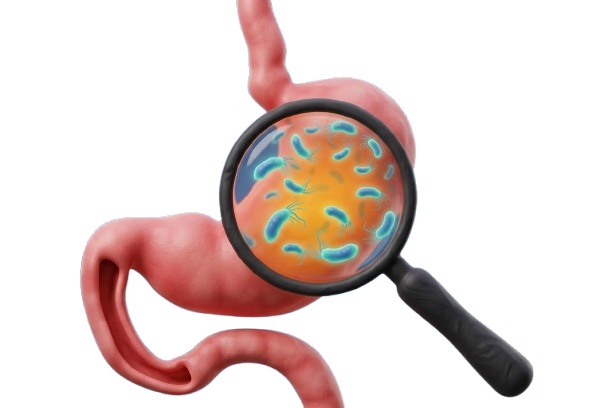
Accurate diagnosis and complex treatment… How do we deal with stomach bacteria?
Imagine that inside your stomach lies a hidden world, unseen by you, inhabited by microorganisms that may affect your health without your knowledge. This organ, which we believe to be protected by its strong acid, is not entirely isolated; it may be home to organisms capable of adapting and surviving.
Among these organisms, a unique bacterium stands out that has been able to defy the harsh environment of the stomach and plays an important role in many digestive disorders.
The stomach bacteria is not just a passing microbe, but a hidden message inviting us to listen more deeply to a body that never stops talking. Yes, when we understand the body, we improve our health and our lives.
The Helicobacter pylori bacterium may seem like a tiny organism, but it reveals that the slightest imbalance can disrupt a remarkably delicate and intricately designed equilibrium. We don’t defeat it with treatment alone; we defeat it when we understand, listen, and live consciously.
Helicobacter pylori
For a long time, doctors believed that the stomach, with its strong acids, was an unsuitable environment for bacteria to live. But in 1982, Australian doctors Barry Marshall and Robin Warren discovered and isolated a type of bacteria that lives in the stomach lining, revolutionizing the understanding of stomach diseases.
This bacterium, known as Helicobacter pylori, is a microscopic organism invisible to the naked eye that lives hidden within the body, taking advantage of any imbalance in the internal environment. When the body’s natural defenses weaken, this bacterium finds an opportunity to establish itself and multiply.
Its spiral shape helps it penetrate the mucous layer that protects the stomach wall, giving it a high ability to survive in a highly acidic environment.
Global medical estimates, including data from the US Centers for Disease Control and Prevention , indicate that about 50% of the world’s population may be infected with this bacterium, with varying rates of spread depending on geographical location and health and environmental conditions.
The stomach under a microscope
If the stomach is capable of digesting meat, why can’t it digest itself?
A question that puzzled many people until recent research revealed an amazing protection system:
- The protective mucus layer covers the stomach wall; a thick layer of alkaline mucus protects the tissue from erosion.
- Cell regeneration at an astonishing rate
- Precise acid secretion control system
- A blood network that nourishes and protects
Clinical signs and symptoms
Most infected people experience no symptoms; the bacteria are often silent. But when symptoms do appear, they vary:
- Stomach pain or burning, especially after eating or at night.
- Frequent bloating and gas.
- Nausea and vomiting sometimes.
- Loss of appetite and unexplained weight loss.
- Blood in vomit or stool in advanced cases.
Biological tests and diagnosis
Diagnosing Helicobacter pylori infection relies on a set of precise tools:
- Urea Breath Test
- Blood tests: to detect antibodies, but may not distinguish between a current and a past infection.
- Stool test: to detect bacterial antigens.
- Gastrointestinal endoscopy with biopsy
Each examination has its own specific accuracy, and the doctor often uses more than one method to ensure the correct diagnosis.
Helicobacter pylori and nutrition
Nutrition plays a dual role: it can alleviate or worsen symptoms.
- Beneficial foods: Fresh vegetables, especially cruciferous vegetables such as broccoli, fruits rich in antioxidants, and fiber that helps soothe the stomach.
- Harmful foods: salty and processed foods, excess fats, sugars and smoked meats, which increase inflammation and accelerate stomach irritation.
- Dietary habits: Eat small, regular meals.
Extravagance in food and the hidden guest
Recent studies have shown that overeating confuses the gastric environment and weakens the protective mucous barrier, which creates a predisposition to gastritis and increases susceptibility to Helicobacter pylori infection.
Treatment
Can the infection be cured? Yes, and the treatment depends on:
- Several antibiotics
- A drug that reduces stomach acid is called a proton pump inhibitor.
The treatment usually lasts 10 to 14 days, and it eliminates the bacteria in 80 to 90% of cases.
However, in 10 to 20% of cases, treatment may fail due to bacterial resistance to antibiotics or non-compliance with the treatment.
In this case, the doctor suggests a new treatment with different antibiotics.
What are the benefits of eliminating bacteria?
- Disappearance of gastritis
- Improvement of digestive symptoms
- Preventing stomach ulcers from occurring or recurring
- Anemia: When anemia becomes a mystery, the doctor begins to think about a hidden guest that confuses the absorption of iron and vitamin B12.
- Reducing the risk of developing stomach cancer among those infected with the bacteria: about 1% may develop stomach cancer.
Are there any contraindications to the treatment?
- Pregnancy
- breastfeeding
In these cases, treatment can be postponed because it is not an urgent matter.
What are the side effects of the treatment?
The treatment may cause some symptoms such as:
- nausea
- diarrhea
- Vomiting
- Loss of appetite
- Change in taste (especially a metallic taste)
- Digestive difficulties
- Headache and dizziness
These symptoms can be bothersome, so it is preferable to start treatment at a suitable time that allows it to be completed to the end.
Test to confirm treatment success
Given that treatment may fail in 10 to 20% of cases, a post-treatment test should be performed to ensure that the bacteria have been eliminated.
The best test is the breath test, which should be performed on an empty stomach for 12 hours, with antacids stopped for two weeks before the test and for at least four weeks after the end of antibiotic treatment.
If the treatment fails, a new treatment is prescribed, and the test is repeated after a month.
Is there a treatment other than antibiotics?
These bacteria can only be eliminated using antibiotics, and they must be taken according to a strict regimen. If the patient does not adhere to the treatment, the bacteria may not be completely eliminated and may become resistant to antibiotics. In this case, another treatment with different antibiotics is required.
Is it possible to get infected again after treatment?
If recovery is confirmed (by testing after stopping antacids and antibiotics), a recurrence of the bacteria is possible but not common, and is often associated with environmental factors or infection from the immediate surroundings.
Can the infection be treated by changing the diet?
Bacteria cannot be eliminated simply by changing the diet.
However, dietary modifications may help reduce stomach irritation and alleviate symptoms.
Can I transmit the infection to others?
The infection is transmitted from person to person through saliva, or food and water contaminated with the feces of the infected person, or sharing eating utensils. Although it is not as contagious as the flu and often requires direct contact or inadequate hygiene conditions, it is medically proven to be a disease that is transmitted between individuals.
Therefore, prevention through handwashing and avoiding sharing personal items is essential to limit its spread.
References
Accurate diagnosis and complex treatment… How do we deal with stomach bacteria?, aljazeera, www.aljazeera.net/health/2026/3/25/تشخيص-دقيق-وعلاج-معقد-كيف-نواجه
Locations
Topics
- From a Harvard expert: 6 “effective” daily tips to slow down aging 1864 January 22, 2026
- Do you watch more than 3 hours of television daily? A study warns of psychological implications. 361 January 23, 2026
- Ebvallo Atara Biotherapeutics Provides Regulatory Update on Ebvallo (tabelecleucel) 358 January 12, 2026
- “NC Band”… the first smart bracelet with medical standards for measuring temperature 355 January 20, 2026
- The US Food and Drug Administration is requesting the removal of the “suicidal thoughts” warning from weight-loss drugs. 350 January 14, 2026