

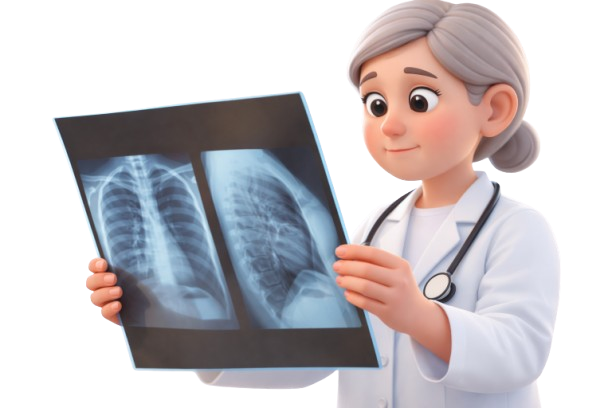
New device detects pneumonia in minutes
In a remarkable scientific development, researchers from the Massachusetts Institute of Technology (MIT) have succeeded in creating a new experimental sensor that could change the way lung diseases, especially pneumonia, are diagnosed by analyzing a person’s breath instead of relying on X-rays or traditional laboratory tests.
How does the technology work?
The new test relies on a very small (chip-sized) sensor that captures synthetic compounds known as “biomarkers,” which are initially attached to inhalable nanoparticles.
These indicators act as “smart tags,” and they only detach from nanoparticles in the presence of a specific “key,” such as enzymes produced by diseases within the body.
Usage mechanism:
- The patient inhales the nanoparticles (similar to an asthma inhaler).
- If the person is healthy, the particles remain as they are and leave the body.
- If it is infected (such as with pneumonia), the disease enzymes will disrupt the vital signs.
- These indicators are released with exhalation.
- The device detects it and confirms the presence of the disease.
The device uses advanced technologies such as spectroscopy and plasmonics, which allow for the detection of very small quantities of these indicators with high accuracy.
The device has shown great efficiency in laboratory experiments, where it was able to identify chemical signals even at very low concentrations.
Why is this innovation important?
It provides a rapid diagnosis within minutes instead of hours or days. It is non-invasive and does not require sampling. It can be used in the future in clinics or even homes. It may contribute to early detection and improve treatment opportunities.
Where has the research reached?
So far, the technology is still in its early stages, having only been tested on animals such as mice, and clinical trials on humans have not yet begun. However, the results have shown high accuracy in detecting disease-related markers.
Broader future prospects
This sensor is not limited to pneumonia; it can be further developed to detect other lung diseases, chemical pollutants in the air, and possibly various diseases that can be tracked via “breath fingerprint”.
Although the technology is still under development, it represents a promising step towards a future where disease diagnosis becomes faster and easier, perhaps as simple as a “puff” into a small device.
References
New device detects pneumonia in minutes, aljazeera, www.aljazeera.net/health/2026/4/13/جهاز-جديد-يكشف-الالتهاب-الرئوي-في
Locations
Topics
- From a Harvard expert: 6 “effective” daily tips to slow down aging 1889 January 22, 2026
- Cases of drug-resistant infection that causes diarrhea are rising: What to know 646 April 14, 2026
- A Distinct New Type of Diabetes Is Now Officially Recognized 644 April 15, 2026
- Recommendations Developed for Prevention of Pediatric Atopic Dermatitis 643 April 14, 2026
- New side effect from smoking cannabis discovered in groundbreaking study 643 April 14, 2026
